
What is Knowledge Distillation in AI?
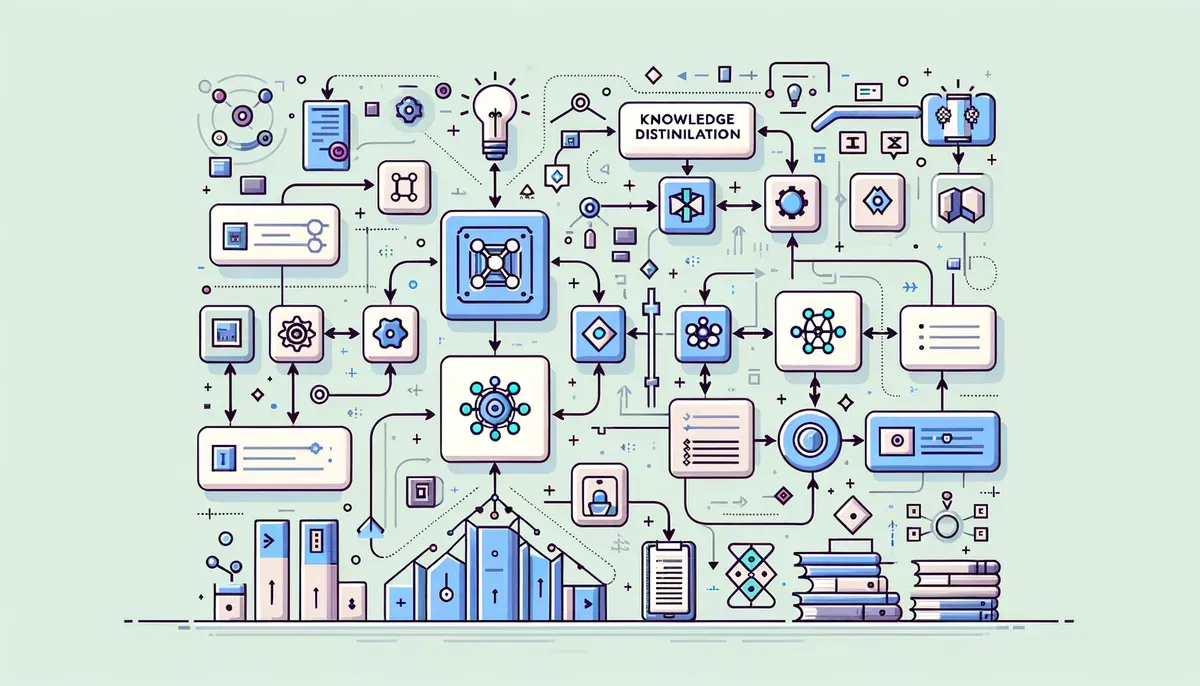
Knowledge distillation for AI models is a technique that facilitates the transfer of knowledge from a large, complex model—often an ensemble of models—to a smaller, more efficient version. This process trains a “student” model to emulate the behavior of a “teacher” model, which typically consists of multiple models working together. By harnessing the predictions and internal representations learned by the teacher, the student model can achieve comparable accuracy while being lighter and quicker to deploy. This approach is especially advantageous for businesses striving to streamline their AI operations and enhance deployment efficiency.
Benefits of Knowledge Distillation for AI Models
The primary benefit of knowledge distillation is its ability to reduce latency in AI production. Smaller models require less computational power and memory, making them ideal for real-time applications where speed is essential. Additionally, knowledge distillation can lead to several advantages:
- Improved operational efficiency: Smaller models can be deployed on edge devices, resulting in enhanced accessibility and responsiveness.
- Cost savings: Reducing model size lowers infrastructure costs associated with cloud services and server maintenance.
- Maintained accuracy: Distilled models often retain a level of accuracy that is comparable to their larger counterparts, maximizing return on investment.
Given these benefits, businesses can leverage knowledge distillation to enhance AI model performance while minimizing training and deployment costs.
How to Train Smaller AI Models Effectively
Training smaller AI models through knowledge distillation involves several key strategies:
- Select an appropriate teacher model: Choose an ensemble model that demonstrates high accuracy for the specific task. This ensures a strong foundation for the student model.
- Define a suitable loss function: The loss function should not only focus on traditional accuracy metrics but also incorporate the soft predictions of the teacher model. This approach helps the student model learn nuances that might otherwise be overlooked.
- Iterate and refine: Techniques such as hyperparameter tuning and regularization during training can further enhance the student model’s performance.
For businesses, investing time in a robust training regimen can yield substantial long-term benefits by creating models that are both efficient and accurate.
Ensemble Models vs Single Models: A Comparison
When assessing ensemble models vs single models, businesses must weigh the trade-offs involved. Ensemble models combine predictions from multiple sources, resulting in improved accuracy and reduced variance. However, they also introduce increased complexity and size, which can pose challenges for deployment and scalability.
| Feature | Ensemble Models | Single Models |
|---|---|---|
| Accuracy | High, due to multiple inputs | Moderate to high |
| Complexity | High; requires management of multiple models | Low; simpler to manage |
| Latency | Higher; longer inference time | Lower; quicker responses |
| Resource Utilization | High; demands more computational power | Low; lighter on resources |
| Deployment | Complex; more steps required | Straightforward; easier to deploy |
Ultimately, the choice between ensemble models and distilled single models often hinges on specific needs for accuracy versus deployability. Knowledge distillation empowers organizations to leverage the strengths of ensemble models while mitigating their downsides.
Optimizing AI Model Performance with Knowledge Distillation
Optimizing AI model performance requires a multifaceted approach. Knowledge distillation is crucial as it enables organizations to compress complex models into more deployable forms without sacrificing accuracy. Here are additional strategies to further enhance model performance:
- Use data augmentation: Expanding the training dataset provides the student model with diverse examples, improving its generalization capabilities.
- Experiment with architectures: Testing different neural network architectures for the student model can help identify the optimal structure that balances size and performance.
- Leverage transfer learning: Utilizing pre-trained models as teachers can reduce training time and enhance efficiency.
By integrating these strategies with knowledge distillation, businesses can develop highly efficient AI models that align with their operational goals.
Practical Applications of Knowledge Distillation
The practical applications of knowledge distillation are extensive and can benefit various industries:
- Retail: AI models can predict customer behavior and personalize recommendations in real-time, boosting sales and enhancing customer satisfaction.
- Healthcare: Distilled models can support diagnostics by enabling faster analysis of medical images, leading to quicker patient outcomes.
- Finance: In fraud detection, smaller, faster models can analyze transactions in real-time, minimizing the risk of losses.
Each of these applications illustrates how knowledge distillation can lead to deployable AI model techniques that efficiently address complex business challenges.
For businesses aiming to optimize their AI operations, investing in knowledge distillation strategies proves to be a valuable pursuit.
Why This Matters
In-depth analysis provides the context needed to make strategic decisions. This research offers insights that go beyond surface-level news coverage.